Glasperlenspiel Music Festival 2027
Wed, July 7th at 7 pm, St. Paul’s church (Riia Str. 27, Tartu)
MARY MAGDALENE GOSPEL
Elina Nechayeva (soprano), Priit Volmer (bass, Estonian National Opera), Riga Dome Church Boys Choir, mixed choir Latvija, Latvian National Symphony Orchestra
Peeter Vähi
I Peuangelion kata Marihamm / Mary Magdalene Gospel
II Jesus’ aria All nature, all formations, all creatures…
III Mary Magdalene’s aria Do not weep and do not grieve…
IV I did not see you descending…
V He who has ears to hear…
VI Say what you wish to say…
VII Peuangelion kata Marihamm / Mary Magdalene Gospel
Peuangelion kata Marihamm, Movement II – Jesus’s aria All nature, all formations, all creatures…, fragment, 4 min 21 sec, mp3)

Music history knows many extensive vocal-symphonic works that are based on the gospels from the New Testament, probably the most famous of them being the Passions by Bach. Considerably less is known about the Gnostic Gospels that were excluded from the New Testament, of which the ones of Judas and Mary Magdalene are especially veiled by mystery. The latter is an apocryphal text, the manuscript of which was found in Egypt. The Coptic script on papyrus dates back to the 5th century. One of the most respected authorities in the field Karen L. King presumes that the text was originally written in Greek already in the early decades of the 2nd century, and its roots reach back to the time of Jesus Christ. The oratorio is based without any exclusions on the original Coptic script.
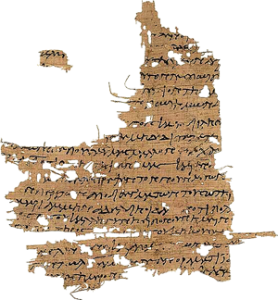 The oratorical works composed on gospel texts are mostly called Passions, however, in this case it would not be justified, since the text of the Gospel of Mary significantly differs from synoptic as well as John’s Gospels. The Gospel of Mary does not tell the story of Jesus’ passion, instead it reveals philosophical reflections by Jesus as well as skeptic and, at times, jealous comments by the apostles. As an example, we can hereby read two fragments:
• The Savior said: “All nature, all formations, all creatures exist in and with one another, and they will be resolved again into their own roots. For the nature of matter is resolved into the roots of its own nature alone.”
• Andrew said to the brethren: “Say what you wish to say about what she has said. I at least do not believe that the Savior said this. For certainly these teachings are strange ideas.” Peter /…/ questioned them about the Savior: “Did He really speak privately with a woman and not openly to us? Are we to turn about and all listen to her? Did He prefer her to us?” /…/ Levi said to Peter: “… if the Savior made her worthy, who are you indeed to reject her? Surely the Savior knows her very well. That is why He loved her more than us…”
The Coptic language belongs – or rather, belonged to the Afro-Asian group of languages and was spoken in Egypt until the 16th century. The written language used Greek alphabet with the addition of 6 borrowed demotic letters from the hieroglyphic script. Coptic was subdivided into dialects among which the two most important ones were Bohairic and Sahidic. The first is until today used in the liturgy of the Coptic Church whereas the latter has become totally extinct. Unfortunately, the Gospel of Mary has been written down namely in Sahidic. As the language is no more spoken, it is extremely difficult to restore the correct pronunciation of the Gospel and thus, the latinisation of the current oratorio possibly contains certain inaccuracy.
The composer said: “While composing this work I have not tried to make a stylisation of Coptic liturgy. Only some percussion instruments (sistrum and Egyptian drums) that are used in the Coptic Church have found their way into the score. I owe my deepest gratitude to Dr. Jaan Lahe for his patience in consulting me in the field of the Coptic language, and to composer Arvo Pärt who supplied me with numerous recordings of the Coptic liturgies.”
The oratorio received the Baltic Assembly Prize for the Arts in 2013.
It is difficult to characterise Peeter Vähi’s work (which is undoubtedly a masterpiece), the influences woven into it and the heavy artillery hidden between its notes. So many impressions and motifs from his earlier works can be heard in this 65-minute musical, emotional, sensitive and even Gothic outburst… All of that is presented by an expanded orchestra in a markedly mystical, melancholy, romantic mood. /…/ The performance of the choir is exceptional, as is that of the orchestra. At times, the forte fortissimos so abundantly used in Verdi’s Requiem seem like child’s play in comparison. (Eņģelis, 24.08.11, Latvia)
More details
Download: original Coptic text and English translation (pdf, 4 pages)
See full festival program
Organizers:
Tiina Jokinen – executive director
Kadri Kiis – producer, accountant
Mart Kivisild – design
Hannah Greete Verbeek – musicologist, editor
Johannes Vähi – co-producer, webmaster
Olavi Sööt – co-producer, video, logistics
Reno Hekkonens – marketing director, PR
Rebeca Birk – social media
Special thanks: Tartu City Government, Urmas Klaas, Ministry of Culture of Estonia, Cultural Endowment of Estonia, Heino Eller Music College, Kadri Leivategija, Tõnis Tamm, Reiman, Canon and Overall, St Paul’s church, Kaupo Kiis, Kristel Leppik, volunteers