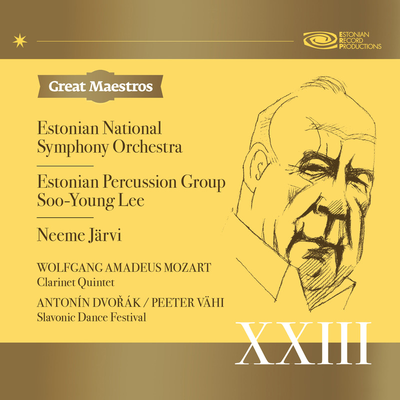
Dedicated to the 90th birthday of Maestro Neeme Järvi.
Wolfgang Amadeus Mozart
Clarinet Quartet in A major, K 581
31:59
1
Allegro
2
Larghetto
3
Menuetto
4
Allegretto con variazioni
Antonín Dvořák / Peeter Vähi
Slavonic Dance Festival*
43:35
5
Furiant
6
Dumka
7
Polka
8
Sousedská
9
Skočná
10
Sousedská II
11
Skočná II
12
Furiant II
#3 Wolfgang Amadeus Mozart. Clarient Quartet. Soo-Young Lee, Estonian National Symphony Orchestra, conductor Neeme Järvi. Fragment, 3 min 35 sec, mp3, 320 Kbps
#5-6 Antonín Dvořák / Peeter Vähi. Slavonic Dance Festival. Estonian Percussion Group, Estonian National Symphony Orchestra, conductor Neeme Järvi. Fragment, 5 min 28 sec, mp3, 320 Kbps
Soo-Young Lee – clarinet (#1-4)
Estonian Percussion Group (#5-12)
Estonian National Symphony Orchestra (concert masters Dalia Dėdinskaitė #1–4; Mari Poll #5–12) Neeme Järvi – conductor
* Published by ERP
Recorded live on November 14th, 2025 (#1–4) and April 29th, 2026 (#5-12) in Estonia Concert Hall, Tallinn
During the winter months of 1778, the 22-year-old Wolfgang Amadeus Mozart made an extended stopover in Mannheim whilst travelling to Paris. At the time, the city boasted one of the finest court orchestras in Europe, featuring instruments whose sound instantly captivated him. “Ah, if only we had clarinetto’s too!” he sighed in a letter to his father, Leopold, in Salzburg. “You would not believe the wonderful effect a symphony has with flutes, oboes, and clarinetto’s!” Mozart used clarinets for the very first time that same summer in his Symphony No. 31 in D major, composed in Paris. A decade later in Vienna, the clarinet had become a fully-fledged member of the woodwind section in his final operas as well as in two of his last symphonies—No. 39 in E-flat major, and No. 40 in G minor. This passion, which ignited in Mannheim, also gave rise to one of the masterpieces of Mozart’s chamber music: the Clarinet Quintet.
Close interactions with the brilliant Viennese virtuosi, the Stadler brothers, allowed the composer to experiment with different types of clarinets. In 1788, at Anton Stadler’s instigation, the imperial court instrument maker Theodor Lotz designed the basset clarinet, which differed from the standard clarinet by extending four semitones lower in range. Mozart was the first to unlock the technical and tonal possibilities of this new instrument. For Anton Stadler, an incomparable ensemble player and soloist, Mozart composed three vital masterpieces: the Trio for Clarinet, Viola, and Piano (“Kegelstatt Trio”), the Quintet for Clarinet and Strings, and the Clarinet Concerto. The latter two were originally written specifically for the basset clarinet. Captivated by Stadler’s playing, the playwright Johann Friedrich Schink wrote: “I should never have thought that a clarinet could imitate the human voice so deceptively… It has such a soft and lovely tone that no one with a heart can resist it.”
The Quintet in A major, KV 581, was completed on 29 September 1789. The work’s premiere took place on 22 December of the same year at a concert organised by the Vienna Tonkünstler-Societät. Even upon first listening, the piece captivates with its tonal magic. Richard Strauss remarked: ‘In every bar, it confirms the unprecedented charm of Mozart’s melodic grace. Yet, beneath the surface of melancholic cheerfulness, this music conceals the entire spectrum of human emotions.’ Indeed, one can hear how the melodies in the primary major key are veiled by minor undertones, how a hidden sadness permeates the quiet tranquility of the themes, and how folk-like characters alternate with touching simplicity and quiet grandeur. The work’s unified core mood stems from the fact that the themes of the first movement, the minuet, and the finale are based on the same descending melodic figure.
The renowned English critic Eric Blom once said: “… music that is too beautiful for this world – a Larghetto which is a meditation where time ceases to exist and nothing remains but pure, comforting listening.”
The autographs of the Clarinet Concerto in A major — which was to be Mozart’s final instrumental work — have not survived. The disappearance of the original material remains an unsolved mystery for researchers to this day. Anton Stadler’s explanations regarding the theft of a travel suitcase containing the sheet music during his extensive European tour did not strike his contemporaries as credible. The version that has persisted is that Stadler, in dire financial straits, sold or pawned them. Relying on copies of the parts in Stadler’s possession, the Viennese publisher Artaria printed the work for the first time in 1802 — adapted for the standard A clarinet — and it remains playable in this form today. Nevertheless, this masterpiece can increasingly be heard both in concert halls and on recordings featuring the original basset clarinet as the solo instrument. Incidentally, the piece will be performed on the basset clarinet at the 2027 Glasperlenspiel Festival. Numerous arrangements of the quintet have been made, even for wind instruments, but most frequently for a larger string ensemble. This is also the case on the present disc, on which the work is recorded with a triple string quartet.
Antonin Dvořák (1841–1904), a towering figure in Czech national music, masterfully combined classical tradition with the melodies and rhythms of Slavic folk music. He was one of the greatest symphonists of the 19th century, whose symphonies and Cello Concerto are performed in concert halls across the globe. Dvořák achieved international renown with his Slavonic Dances, composed in 1877 at the request of the publisher Simrock.
Dvořák’s Slavonic Dances were inspired by Johannes Brahms’s highly successful Hungarian Dances. Unlike Brahms, Dvořák did not use actual folk melodies but composed the dances himself, strictly following folk traditions. The majority of the Slavonic Dances are Czech dances, complemented by a Ukrainian dumka, a Serbian kolo, and a Slovak odzemek.
Written for piano duet, the Slavonic Dances were an immense success, with the sheet music selling out in a single day. Orchestral versions were soon published in two series, Op. 46 and Op. 72.
Dvořák also incorporated dances based on folk motifs into many of his other works. His favourite was the pensive dumka, which can be heard, for example, in his Piano Quintet No. 2 and in the Trio, Op. 90, which consists entirely of dumkas. The furiant, a Czech dance, features in the third movement of both Dvořák’s Sixth and Seventh Symphonies.
Estonian composer Peeter Vähi stands out in the contemporary music landscape for his distinctive approach and for bringing together different worlds – Eastern and Western musical thought, archaic and contemporary, acoustic and electronic. Studying at the Tallinn Conservatory under Prof. Eino Tamberg, Vähi’s early works were in the avant-garde and later neoclassical styles. Over time, he developed a deep interest in traditional music from the Orient. Vähi’s list of compositions is diverse, comprising a wide range of genres – from orchestral works to chamber music and multimedia pieces. His expressive palette is broad, offering both meditative-philosophical moods and energetic rhythms along with motoric movement. Vähi often incorporates elements from the music of various cultures, and in vocal works, uses different languages. Additionally, traces of his background as a former pop and rock musician occasionally can be seen in his compositions. His works often feature exotic or rarely explored instruments, for example he has written pieces for bamboo flute, a bell ensemble and birbynė. According to musicologist Evi Arujärv, Vähi’s music has increasingly emphasized its conceptual side – the message within the music and its ritualistic performance, as well as the sonic and symbolic uniqueness of the material. In addition to his creative work, Vähi has served as a producer at Eesti Kontsert and taught Asian music at the Estonian Academy of Music and Theatre. He is the artistic director of the Glasperlenspiel and Orient music festivals and runs the record label Estonian Record Productions. He is also known as a world traveller and photographer.
An interview with composer Peeter Vähi might also give some sort of picture of the re-composition.
What is it about Dvořák’s “Slavonic Dances” that is special to you?
Naturally, both of Dvořák’s suites are familiar to me from numerous concerts and records, but these dances used to be just one set among hundreds of others to me. However, about a year and a half ago, Maestro Järvi invited me over to listen to this music, drew my attention to various nuances, and tossed out the idea of adding a solo percussion quartet to the score. I must admit that it was only then that I discovered for myself the uniqueness of the “Slavonic Dances” and the magical power hidden within them.
Did you have a particular role model for how to treat a classical work creatively?
There are many examples where original works have not just been arranged, but to a greater or lesser extent recomposed. Take, for instance, the Bizet-Shchedrin “Carmen Suite”, Bach-Gounod’s “Ave Maria”, Vivaldi-Richter’s “Four Seasons”… None of the aforementioned served as a model for me. I feel a deep respect for the masterpieces of the great classics; nevertheless, I have dared to accept offers to recompose Beethoven’s piano sonatas for orchestra. Back then, I tried to “connect directly” with Beethoven himself, and now it was the turn of the “Slavonic Dances”. Although I significantly developed the orchestration, slightly increased the size of the orchestra, added percussion soloists, left out some of the original music, composed about a quarter of it myself from scratch, and occasionally altered keys, metres, tempos, dynamics, and strokes… I did so in good faith that if Dvořák were living in the 21st century, perhaps he too would move in a somewhat similar direction, or at least wouldn’t be angry with me.
Which percussion instruments did you use?
When you have four superb percussionists on stage with a rich instrument park, plus the unlimited opportunity to use all of ENSO’s instruments, and when my own collection contains dozens of exotic percussion instruments, it is easy to be tempted to use this and that and that… I know of several contemporary percussion concertos that require a lorryload of gear and a couple of roadies to handle the loading and setting up. It can all be very spectacular and grand, but it makes future performances of the piece exceptionally complicated, if not impossible.
I tried not to give in to such temptation and to stick to a fairly traditional selection of instruments, the only exception being the zatula – since these are Slavonic dances, there might as well be a Slavonic (specifically Ukrainian) instrument. And so: Glockenspiel, vibraphone, marimba, tubular bells, four timpani, frame drum, tam-tam, triangle, cymbals, four tom-toms, three small bells, bass drum and the afore-mentioned zatula.
An attentive ear noticed that you have also fitted the Estonian Tuljak dance tune between the Slavonic dances?
To this, I would answer both “yes” and “no”. Namely, there is a melody in Dvořák’s Polka that is very similar to our Tuljak; I only changed a couple of notes, thereby increasing the similarity even further. I also gave it to the brass section, which makes it particularly prominent now.
The Estonian National Symphony Orchestra (ERSO) is a vivid and versatile orchestra who’s always striving towards excellence. Since the 2020/21 season, its Chief Conductor and Artistic Director is Olari Elts. Neeme Järvi, the longest-serving chief conductor of the ERSO, continues to cooperate with the orchestra as an Honorary Artistic Director for Life and the Artistic Adviser of the orchestra is Paavo Järvi. The orchestra performs with renowned conductors and soloists from around the world, including most prominent Estonian musicians. ERSO’s CDs demonstrate a quality that has been recognised by several renowned music magazines and the orchestra has won several prizes, including a Grammy Award for the recording of cantatas by Sibelius. Its home venue is the Estonia Concert Hall in Tallinn and it has dazzled the world with numerous tours and participated in reputable international music festivals. They have played in prestigious venues such as the Konzerthaus Berlin, Musikverein in Vienna, Rudolfinum in Prague, Brucknerhaus in Linz, the Avery Fisher Hall in New York, the Grand Hall of St. Petersburg Philharmonia and the Concert Hall of the Mariinsky Theatre, the Kölner Philharmonie, the Helsinki Music Centre, Berwaldhallen in Stockholm, and many more. Some of the festivals ERSO has attended include the Festival Radio France Occitanie Montpellier with Neeme Järvi and the Eufonie International Festival of Central and Eastern Europe in Warsaw under the baton of Olari Elts. In May 2023, a successful concert tour took the orchestra to Great Britain, where 11 concerts were given with pianist Barry Douglas under the baton of Olari Elts. The orchestra has enjoyed fruitful cooperation with highly acclaimed record companies such as Chandos, BIS, and Onyx, and in the past also with Alba Records, Harmonia Mundi, Melodiya and ERP. In addition to local radio and television channels, ERSO’s concerts have been broadcasted by Mezzo, medici.tv and they have also reached many radio listeners via the EBU. In 2020, the orchestra launched its own channel – erso.tv.
The head of a musical dynasty, Neeme Järvi is one of today’s most highly respected maestros. He conducts the world’s most prominent orchestras and works alongside soloists of the highest calibre. Neeme Järvi has held the position of chief conductor (currently chief conductor emeritus) of Gothenburg Symphony Orchestra and Royal Scottish National Orchestra (currently honorary conductor), music director of Detroit Symphony Orchestra (currently music director emeritus), music director of New Jersey Symphony Orchestra (currently honorary conductor), chief conductor of the Hague Residentie-orchestra (currently chief conductor emeritus), music director of Orchestre de la Suisse Romande etc. A prolific recording artist, he has amassed a discography of nearly 500 recordings. Among others, he has recorded all symphonies by Prokofiev, Shostakovich, Strauss, Mahler, Dvořák, Glazunov, Sibelius, Nielsen and Brahms. Järvi has also championed less widely known composers such as Wilhelm Stenhammar, Hugo Alfvén, Niels Gade, Franz Berwald, Johan Svendsen and Johan Halvorsen and composers from his native Estonia including Rudolf Tobias, Artur Kapp, Eduard Tubin and Arvo Pärt. Throughout his career he has recorded with Chandos, Deutsche Grammophon, BIS and EMI amongst others.
Having served as chief conductor of the Estonian National Symphony Orchestra from 1963 to 1979, Järvi took a difficult decision in 1980 to emigrate to the US. In 2010, he was again appointed artistic director and chief conductor of ERSO, being the only conductor who has held this position for two different periods. From the summer of 2020 he continues as its Honorary Artistic Director for Life. In 2001, Neeme Järvi with his two sons, conductors Paavo and Kristjan, initiated the international conducting master classes in Pärnu which by now have grown into the Järvi Academy and Pärnu Music Festival. Neeme Järvi has been honoured with many international awards and accolades. He holds an honorary doctorate of Humane Letters from Detroit’s Wayne State University and the University of Michigan, as well as honorary doctorates from the University of Aberdeen and the Royal Swedish Academy of Music. He has also received the Commander of the North Star Order from King Carl XVI Gustaf of Sweden. In 2018, Maestro Järvi received Gramophone’s Life Achievement Award, and in 2020, the Life Achievement Award of the Cultural Endowment of Estonia.
Download the liner notes in Estonian language (PDF)